
课程明细
Circuits Analysis
- 星期一,第 3—4 节,1—16 周,南校区博学楼 1J1B403;教学班:C电气251、C电气252。
- 星期三,第 1—2 节,1—16 周,南校区博学楼 1J1D317;教学班:C电气251、C电气252。
电工电子学A
- 星期一,第 5—6 节,1—12 周,南校区博学楼 1J1D410;教学班:C机制253、C机制254。
- 星期三,第 9—10 节,1—12 周,南校区博学楼 1J1C305;教学班:C机制253、C机制254。
- 星期五,第 5—6 节,1—12 周,南校区博学楼 1J1D410;教学班:C机制253、C机制254。
补充知识
- 什么是电阻: https://zhidao.baidu.com/daily/view?id=183681
- 电阻应用浅析: https://www.eet-china.com/mp/a416198.html
- 集总参数电路和分布参数电路: https://www.zhihu.com/question/320087308
作业
第一章作业
第1题
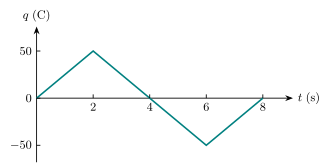
The charge flowing in a wire is plotted in Fig. 1.21. Sketch the corresponding current.
第2题
The current entering the positive terminal of a device is \(i(t)=3e^{-2t}\,\mathrm A\), and the voltage across the device is \(v(t)=5\,di/dt\,\mathrm V\).
- Find the charge delivered to the device between \(t=0\) and \(t=2\,\mathrm s\).
- Calculate the power absorbed.
- Determine the energy absorbed in 3 s.
第3题
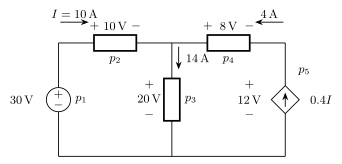
Find the power absorbed by each of the elements in Fig. 1.26.
第二章作业
第1题
Find the hot resistance of a lightbulb rated 60 W, 120 V.
第2题
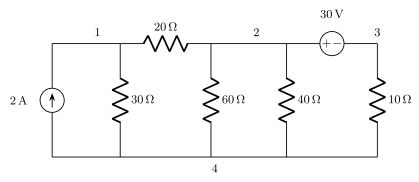
Determine the number of branches and nodes in the circuit.
第3题
Calculate the power dissipated in the \(5\,\Omega\) resistor in the circuit of Fig. 2.82.
第4题
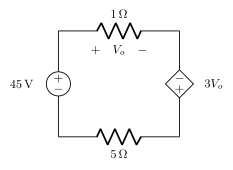
Find \(V_o\) in the circuit in Fig. 2.83 and the power dissipated by the controlled source.
第5题
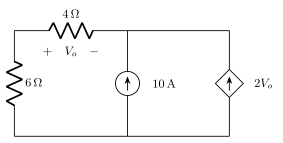
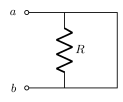
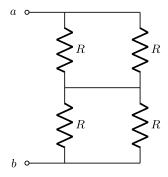
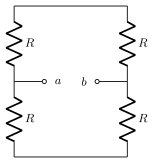
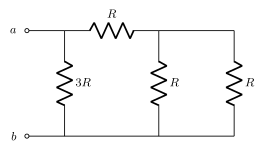
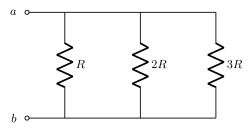
Find the equivalent resistance at terminals \(a\)-\(b\) for each of the networks in Fig. 2.99.
第6题
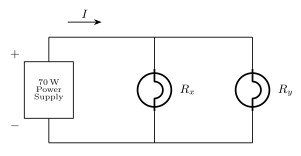
As a design engineer, you are asked to design a lighting system consisting of a 70-W power supply and two lightbulbs as shown in Fig. 2.118. You must select the two bulbs from the following three available bulbs.
- \(R_1=80\,\Omega\), cost = $0.60 (standard size)
- \(R_2=90\,\Omega\), cost = $0.90 (standard size)
- \(R_3=100\,\Omega\), cost = $0.75 (nonstandard size)
The system should be designed for minimum cost such that \(I=1.2\,\mathrm A\pm5\%\).
第三章作业
第1题
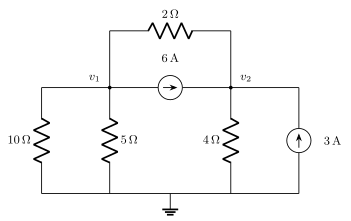
For the circuit in Fig. 3.51, obtain \(v_1\) and \(v_2\).
第2题
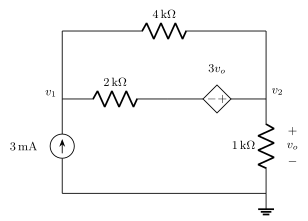
For the circuit in Fig. 3.66, find \(v_1\) and \(v_2\) using nodal analysis.
第3题
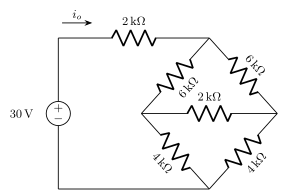
For the bridge network in Fig. 3.76, find \(i_o\) using mesh analysis.
第4题
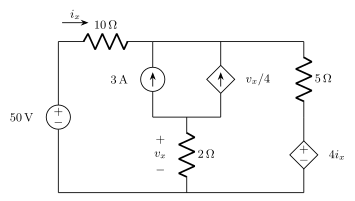
Find \(v_x\) and \(i_x\) in the circuit shown in Fig. 3.91.
第四章作业
第1题
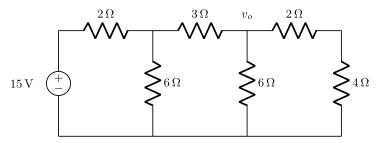
For the circuit in Fig. 4.73, assume \(v_o=1\,\mathrm V\), and use linearity to find the actual value of \(v_o\).
第2题
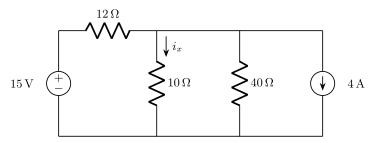
Given the circuit in Fig. 4.75, calculate \(i_x\) and the power dissipated by the \(10\,\Omega\) resistor using superposition.
第3题
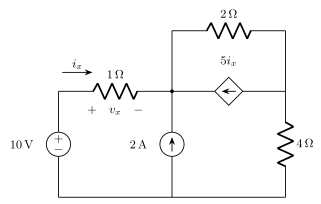
Find \(v_x\) in Fig. 4.83 by superposition.
第4题
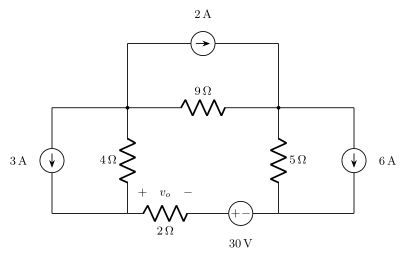
Obtain \(v_o\) in the circuit of Fig. 4.87 using source transformation. Check your result using PSpice.
第5题
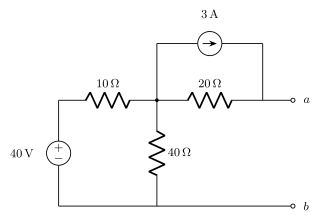
Find the Thevenin equivalent at terminals \(a\)-\(b\) of the circuit in Fig. 4.93.
第6题
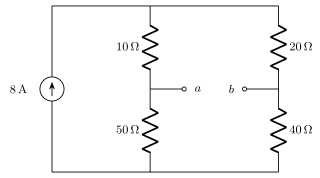
Determine the Thevenin and Norton equivalents at terminals \(a\)-\(b\) of the circuit in Fig. 4.107.
第7题
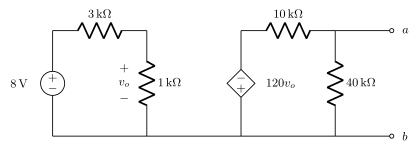
For the circuit in Fig. 4.117, what resistor connected across terminals \(a\)-\(b\) will absorb maximum power from the circuit? What is that power?
第六章作业
第1题
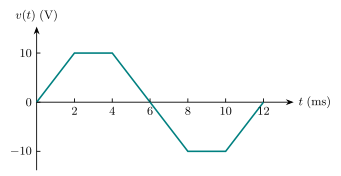
The voltage waveform in Fig. 6.46 is applied across a \(30\,\mu\mathrm F\) capacitor. Draw the current waveform through it.
第2题
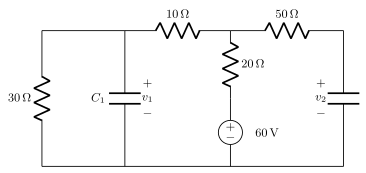
Find the voltage across the capacitors in the circuit of Fig. 6.49 under dc conditions.
第3题
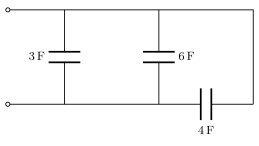
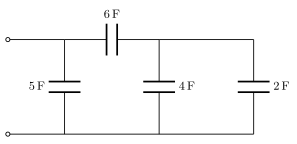
Determine the equivalent capacitance for each of the circuits in Fig. 6.51.
第4题
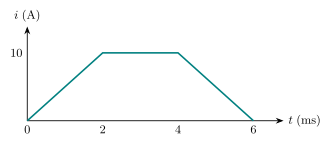
The current through a \(5\,\mathrm{mH}\) inductor is shown in Fig. 6.66. Determine the voltage across the inductor at \(t=1,3,\text{ and }5\,\mathrm{ms}\).
第5题
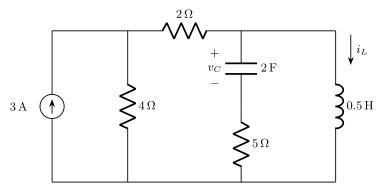
Under DC conditions, find energy and voltage of capacitor and inductor.
第6题
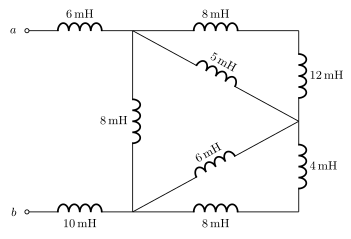
Find \(L_{\mathrm{eq}}\) at the terminals of the circuit in Fig. 6.75.
第七章作业
第1题
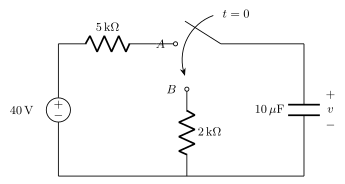
The switch in Fig. 7.84 moves instantaneously from \(A\) to \(B\) at \(t=0\). Find \(v\) for \(t>0\).
第2题
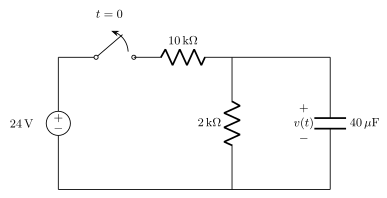
The switch in Fig. 7.86 has been closed for a long time, and it opens at \(t=0\). Find \(v(t)\) for \(t\ge0\).
第3题
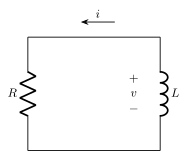
In the circuit of Fig. 7.93, \[v(t)=20e^{-10^3t}\,\mathrm V,\qquad t>0,\] \[i(t)=4e^{-10^3t}\,\mathrm{mA},\qquad t>0.\]
- Find \(R\), \(L\), and \(\tau\).
- Calculate the energy dissipated in the resistance for \(0\lt t\lt0.5\,\mathrm{ms}\).
第4题
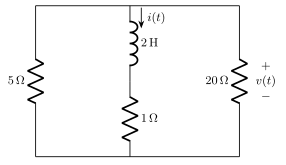
Find \(i(t)\) and \(v(t)\) for \(t>0\) in the circuit of Fig. 7.102 if \(i(0)=10\,\mathrm A\).
第5题
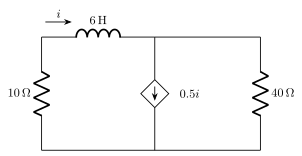
In the circuit of Fig. 7.99, find \(i(t)\) for \(t>0\) if \(i(0)=2\,\mathrm A\).
第九章作业
第1题
For the following pairs of sinusoids, determine which one leads and by how much.
- \(v(t)=10\cos(4t-60^\circ)\) and \(i(t)=4\sin(4t+50^\circ)\).
- \(v_1(t)=4\cos(377t+10^\circ)\) and \(v_2(t)=-20\cos377t\).
- \(x(t)=13\cos2t+5\sin2t\) and \(y(t)=15\cos(2t-11.8^\circ)\).
第2题
Using phasors, find:
- \(3\cos(20t+10^\circ)-5\cos(20t-30^\circ)\)
- \(40\sin50t+30\cos(50t-45^\circ)\)
- \(20\sin400t+10\cos(400t+60^\circ)-5\sin(400t-20^\circ)\)
第3题
Using phasors, determine \(i(t)\) in the following equations:
- \(2\dfrac{di}{dt}+3i(t)=4\cos(2t-45^\circ)\)
- \(10\int i\,dt+\dfrac{di}{dt}+6i(t)=5\cos(5t+22^\circ)\)
第4题
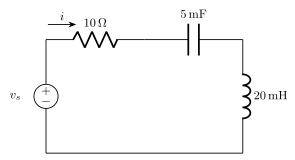
Find current \(i\) in the circuit of Fig. 9.42, when \(v_s(t)=50\cos200t\,\mathrm V\).
第5题
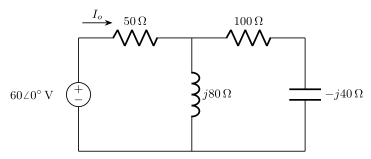
Find current \(I_o\) in the circuit shown in Fig. 9.50.
第6题
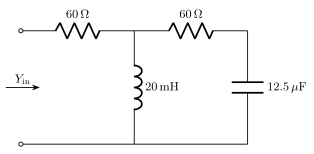
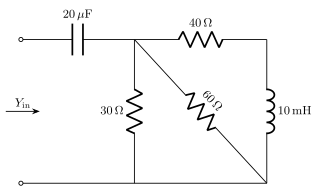
At \(\omega=10^3\,\mathrm{rad/s}\), find the input admittance of each of the circuits in Fig. 9.74.
第十章作业
第1题
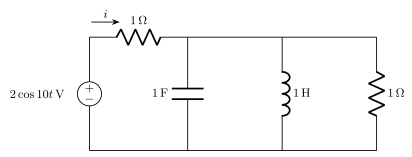
Determine \(i\) in the circuit of Fig. 10.50.
第2题
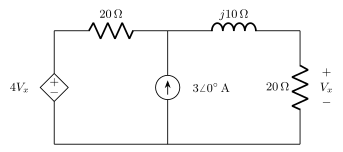
Determine \(V_x\) in Fig. 10.55.
第3题
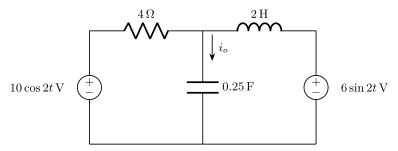
Solve for \(i_o\) in Fig. 10.73 using mesh analysis.
第4题
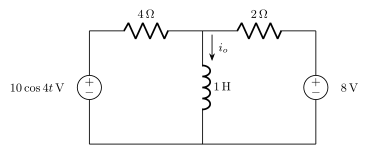
Find \(i_o\) in the circuit shown in Fig. 10.85 using superposition.
第5题
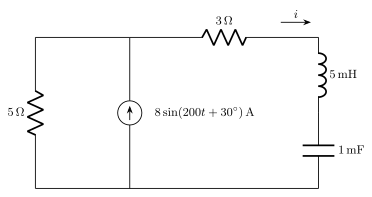
Using source transformation, find \(i\) in the circuit of Fig. 10.94.
第6题
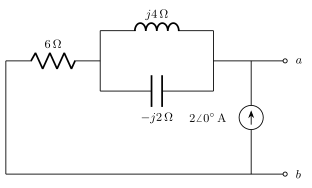
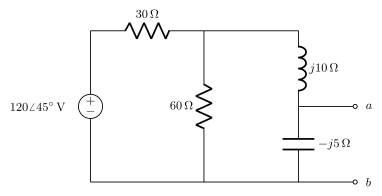
For each of the circuits in Fig. 10.99, obtain Thevenin and Norton equivalent circuits at terminals \(a\)-\(b\).
第十一章作业
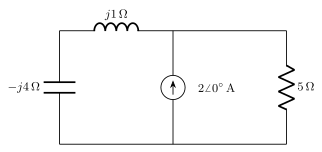
第1题
Given the circuit in Fig. 11.35, find the average power supplied or absorbed by each element.
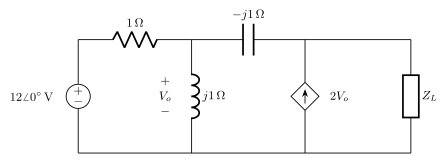
第2题
In the circuit of Fig. 11.46, find the value of \(Z_L\) that will absorb the maximum power and the value of the maximum power.
第3题
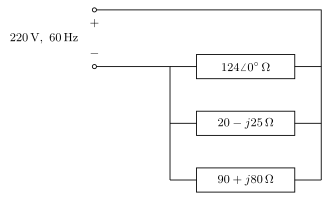
For the power system in Fig. 11.67, find: (a) the average power, (b) the reactive power, (c) the power factor. Note that 220 V is an rms value.
第4题
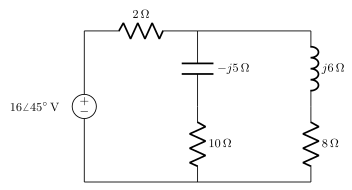
For the entire circuit in Fig. 11.70, calculate:
- The power factor
- The average power delivered by the source
- The reactive power
- The apparent power
- The complex power
第十二章作业
第1题
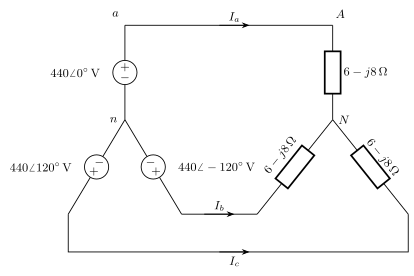
Obtain the line currents in the three-phase circuit of Fig. 12.42.
第2题
In the balanced three-phase Y–\(\Delta\) system in Fig. 12.46, find the line current \(I_L\) and the average power delivered to the load.
第3题
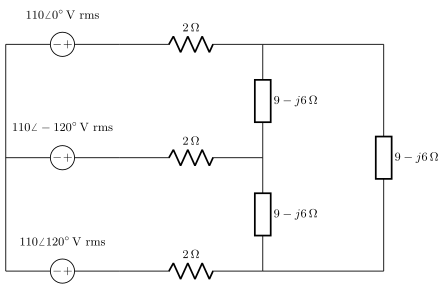
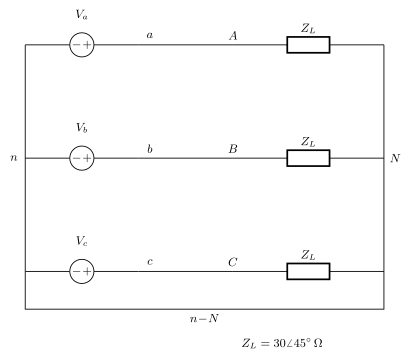
In Fig. 12.56, the rms value of the line voltage is 208 V. Find the average power delivered to the load.
第4题
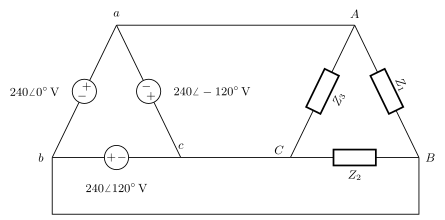
Consider the \(\Delta\)–\(\Delta\) system shown in Fig. 12.60. Take \(Z_1=8+j6\,\Omega\), \(Z_2=4.2-j2.2\,\Omega\), and \(Z_3=10+j0\,\Omega\).
- Find the phase currents \(I_{AB}\), \(I_{BC}\), and \(I_{CA}\).
- Calculate line currents \(I_{aA}\), \(I_{bB}\), and \(I_{cC}\).
第十三章作业 · Magnetically Coupled Circuits
Alexander & Sadiku, Fundamentals of Electric Circuits, Chapter 13, Problems: 13.1, 13.4, 13.8, 13.10, 13.15, 13.36, 13.41, 13.45.
Unless otherwise specified, all voltages and currents in this chapter are rms values. A coefficient in a time-domain sinusoidal expression is its peak amplitude.
Problem 13.1
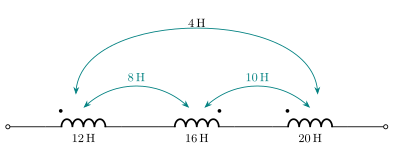
For the three coupled coils in Fig. 13.72, calculate the total inductance.
Problem 13.4
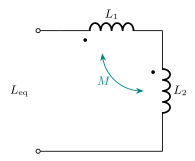
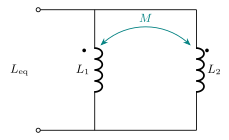
(a) For the coupled coils in Fig. 13.74(a), show that \[L_{\mathrm{eq}}=L_1+L_2+2M.\]
(b) For the coupled coils in Fig. 13.74(b), show that \[L_{\mathrm{eq}}=\frac{L_1L_2-M^2}{L_1+L_2-2M}.\]
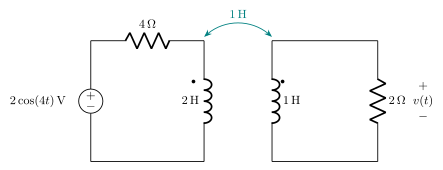
Problem 13.8
Find \(v(t)\) for the circuit in Fig. 13.77.
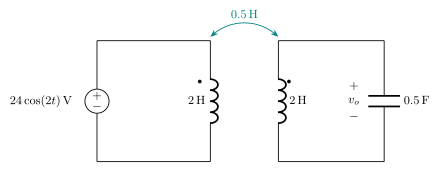
Problem 13.10
Find \(v_o\) in the circuit of Fig. 13.79.
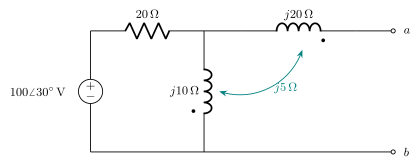
Problem 13.15
Find the Norton equivalent for the circuit in Fig. 13.84 at terminals \(a\)-\(b\).
Problem 13.36
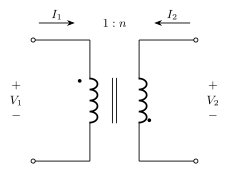
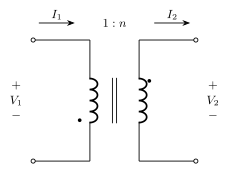
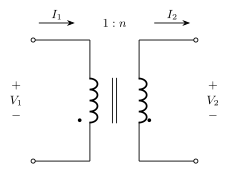
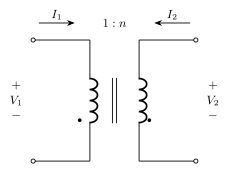
As done in Fig. 13.32, obtain the relationships between terminal voltages and currents for each of the ideal transformers in Fig. 13.105.
Problem 13.41
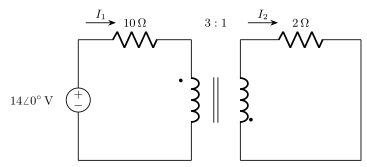
Determine \(I_1\) and \(I_2\) in the circuit of Fig. 13.106.
Problem 13.45
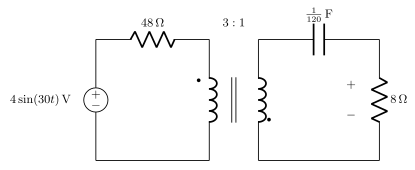
For the circuit shown in Fig. 13.110, find the value of the average power absorbed by the \(8\,\Omega\) resistor.
还没有可见的评论。